St. Joseph Shrine - Photos (interior)
St. Joseph Shrine

The Death of St. Joseph Window in the south nave was imported from Innsbruck, Austria. The subject is one not usually depicted.

Other stained glass was bought in Detroit from the firm of Friederichs & Staffin, whose owners were parishioners.

But they are not entirely by Mayer, only the figures with their pedestals and bases came from Munich. The geometric designs in red, yellow, and blue above and below the figures were made by Friederichs & Staffin of Detroit, based on a design by architect Himpler
.jpg)
The rose window is a Friederichs family gift.

The rose window depicts Christ among saints.

The rose window depicts Christ among saints.

The rose window depicts Christ among saints.

The window of The Good Shepherd is a fitting memorial for the Reverend J. F. Friedland under whose direction St. Joseph and its parish came to full flowering. The Good Shepherd, adapted from the Roman sculpture of a shepherd boy and his lamb, is one of the oldest Christian symbols.

In the catacombs of Rome there is a Good Shepherd picture painted in the fourth century A.D., probably just before Emperor Constantine offi¬cially recognized Christianity. The figure of Christ represented in this window is typical in Detroit churches of this period, as Victorian Gothic stylistically favored the Renaissance figures rather than the stylized ones of the medieval Gothic period. Renaissance realism tended to become sentimental in the nine¬teenth century, and we see here Christ as a human being ten¬derly tending his flock. The Good Shepherd symbol is still a favorite one today and can be found in almost every church denomination in Detroit.

Note too the canopies and architecture filling the top of the window, a favorite design for tall windows for they admirably fill in space.

Some detail of the windows made by Friederichs & Staffin of Detroit

Some detail of the windows made by Friederichs & Staffin of Detroit

The window of The Good Shepherd and the rose window to the right, as seen from the opposite side of the church.

The window of The Good Shepherd and the rose window from a slightly different perspective.

The fittings of St. Joseph Shrine are especially noteworthy. In a period when much decoration was done by molding plaster, St. Joseph was built with carved wood ornament.

The altars, numerous statues, four confessionals, and high pulpit are all of wood, without cast ornament.

Many of the decorations were imported from Germany

Many of the decorations were imported from Germany - the high altar, almost all the statues, and the stations of the cross.
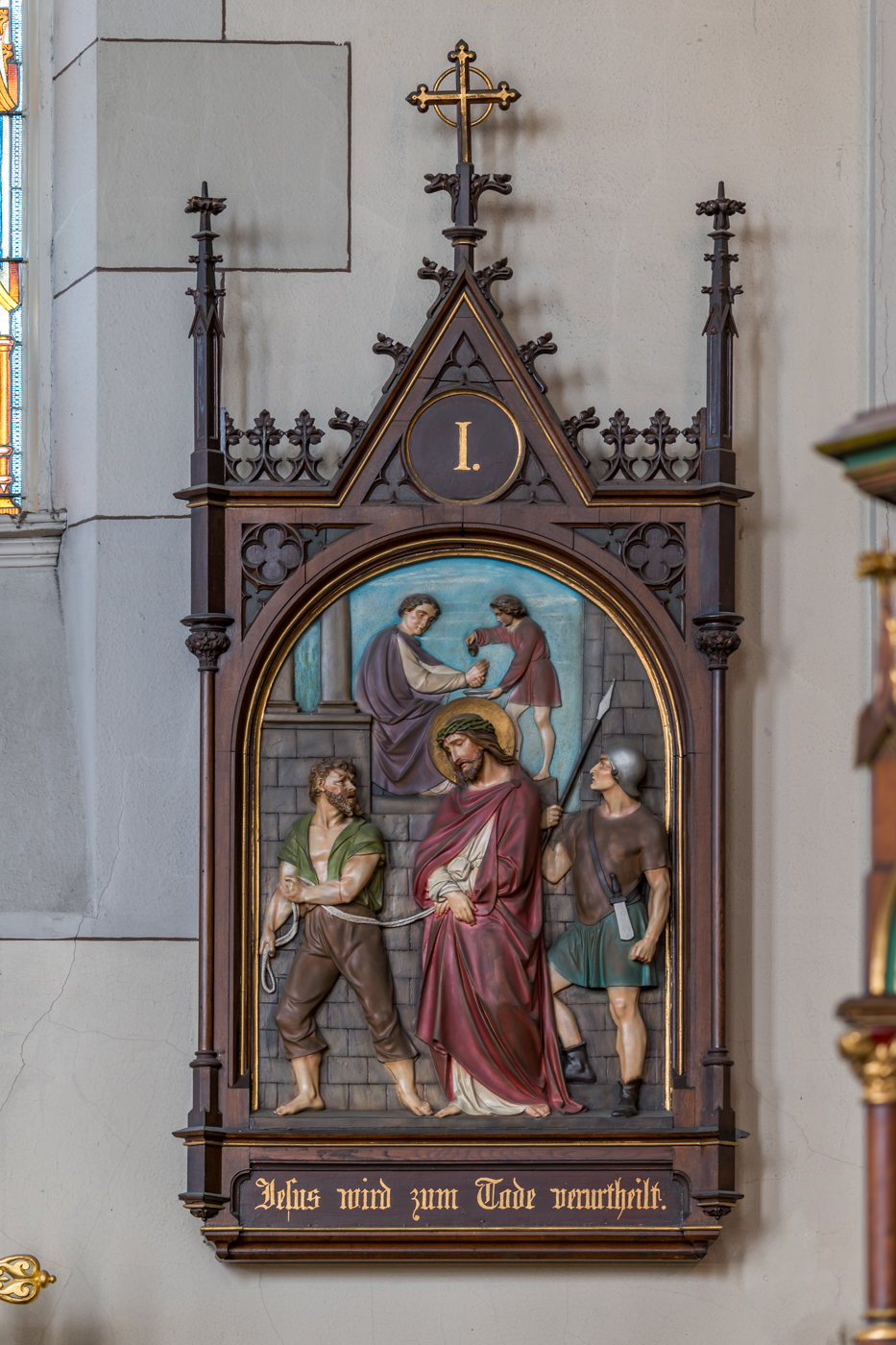
Station 1: Jesus is condemned to death

Station 2: Jesus is made to bear his cross

Station 3: Jesus falls the first time

Station 4: Jesus meets his mother

Station 5: Simon of Cyrene is made to bear the cross

Station 6: Veronica wipes Jesus’ face

Station 7: Jesus falls the second time

Station 8: the women of Jerusalem weep over Jesus

Station 9: Jesus falls the third time

Station 10: Jesus is stripped of his garments

Station 11: Jesus is nailed to the cross

Station 12: Jesus dies on the cross

Station 13: Jesus is taken down from the cross, and

Station 14: Jesus is placed in the sepulchre

Other decorative items were made in Detroit, partly by a craftsman named Anthony Osebold, who belonged to the parish.
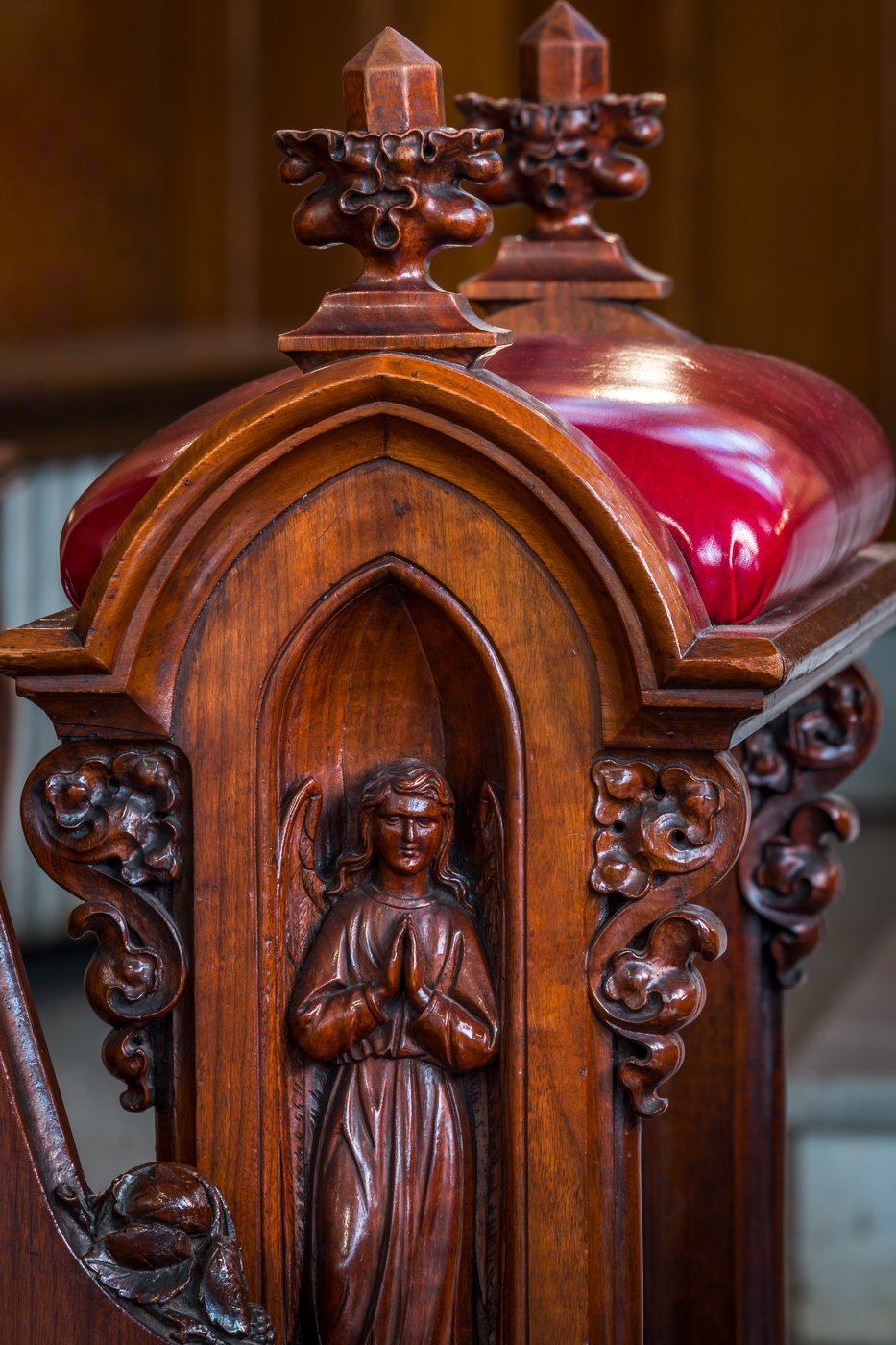
More examples of carved wood ornaments

More examples of carved wood ornaments

More examples of carved wood ornaments

More examples of carved wood ornaments

Sacred music has always been of great importance at St. Joseph, and the acoustics are outstanding.

The church was dedicated on November 16, 1873, with a Mass by Haydn presented by the choir and the Detroit Opera House orchestra. The original organ was built in 1873 by J.H. & C.S. Odell of New York

The case, however, was built in Detroit by William Mayer. It is the last 19th century case in Detroit to remain unaltered; even the original stenciling of the facade pipes survives. The organ itself, however, went through many changes over the years. In honor of the centennial of the church building, a new instrument was installed using many pipes from the Odell.

Between 1900 and 1915, the floor of marble mosaic was laid and the brass light fixtures were installed.

Between 1900 and 1915, the floor of marble mosaic was laid and the brass light fixtures were installed.

The church truly gives an impression of a single, soaring, space.

All brass light fixtures were installed between 1900 and 1915.

All brass light fixtures were installed between 1900 and 1915.

Some detail of the high altar
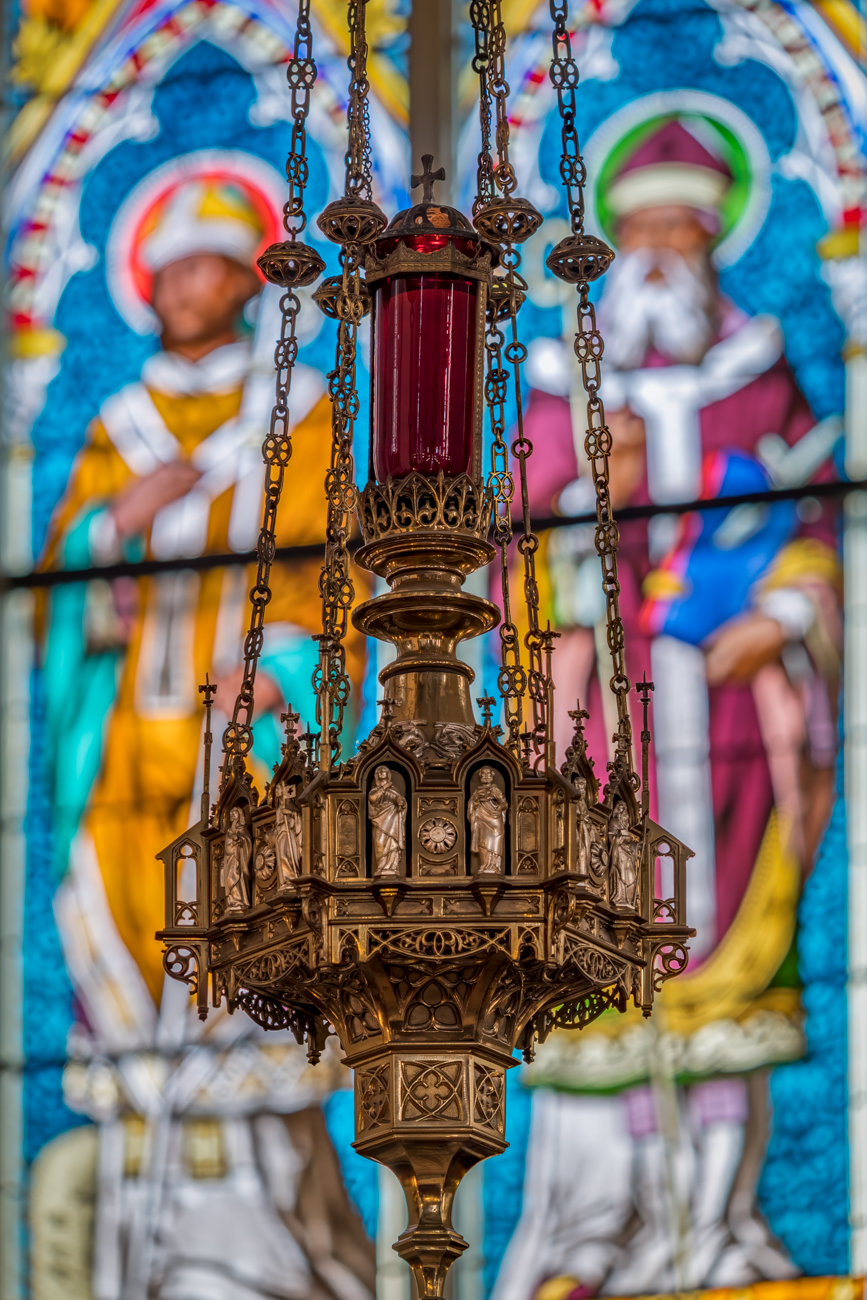
Detail shot of the Brass Altar Hanging Sanctuary Lamp

Another detail shot of the Brass Altar Hanging Sanctuary Lamp

St. Matthias sculpture

Saint Bartholomew sculpture

Saint Andrew sculpture

Another look at the interior of this stunningly beautiful and historic church.